Thursday, September 11, 2008

Ashta Chamma (2008)

Cast: Nani,"Colours"Swathi,Srinivas Avasarala
Music Director: kalyani Malik

Director: Mohan Krishna Indraganti

lyrics:Sirivennela Sitarama Sastri

Producer: P.Ram Mohan

Audio On: Big Music

Year: 2008

Tracklist

01.Nammalo Ledo02.Hello Antoo03.Aadinchi Ashta Chamma04.Tidathara Kodathara05.Ashta - Chamma Theme


http://rapidshare.com/files/13605783..._Ramakanth.rar
or
http://w17.easy-share.com/1701171450.html

Wednesday, September 10, 2008

Kotta Bangaru Lokam (2008)


Music: Mickey JMayor
Cast: Varun Sandesh Swetha Prasad

Track List

Kalasalalo
Artist(s): Krishna Chaitanya,Adithya,Siddhartha, Kranthi,Sasikiran
Lyricist: Srikanth Addala

Nijamgaa Nenena
Artist(s): karthik
Lyricist: Ananth Sriram

Confusion
Artist(s): Krishna Chaitanya,Mickey J Mayor
Lyricist: Ananth Sriram

Nenani Neevani
Artist(s): Swetha Prasad
Lyricist: Seetharama Sastry

Ok Anesa
Artist(s): Naresh Iyer,Kalyani
Lyricist: Seetharama Sastry

Nee Prashnalu
Artist(s): S.P.Balasubramaniam
Lyricist: Seetharama Sastry


http://rapidshare.com/files/141958332/Kotta_Bangaru_Lokam.rar

mallepuvvu (2008)


128 KBPS CD-Rips ,MP3 Format,High Quality,Compressed 34 MB Only.Download


http://rapidshare.com/files/134928003/Mallepuvvu.rar

Will This World End On Today(Wednesday)

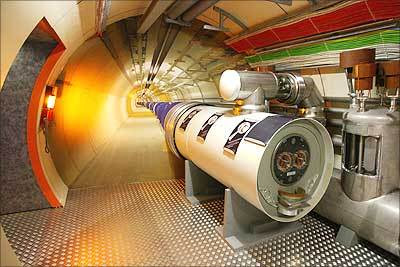
It is one of the biggest and most controversial experiments to be carried out in recent times. On September 10, a machine costing a staggering $7.75 billion (Rs 31,000 crore) will be fired up to recapture conditions not seen since the birth of the universe almost 14 billion years ago. The machine, located at CERN, a Geneva-based nuclear research lab, will carry on the experiment inside a 27-km tunnel

The news of the experiment has evoked resentment from some experts, who feel that such an experiment could cause the end of the universe.
In fact, scientists working on to recreate forces that occurred immediately after the Big Bang have received death threats.
The Large Hadron Collider will fire particles around the tunnel. It will then smash protons -- one of the building blocks of matter -- into each other at energies up to seven times greater than ever achieved.
LHC is the world's most powerful particle accelerator, producing beams seven times more energetic than any previous machine, and around 30 times more intense when it reaches design performance, probably by 2010. It relies on technologies that would not have been possible 30 years ago. The LHC is, in a sense, its own prototype.
Starting up such a machine is not as simple as flipping a switch. Commissioning is a long process that starts with the cooling down of each of the machine's eight sectors.
This is followed by the electrical testing of the 1600 superconducting magnets and their individual powering to nominal operating current
These steps are followed by the powering together of all the circuits of each sector, and then of the eight independent sectors in unison in order to operate as a single machine.

Once stable circulating beams have been established, they will be brought into collision, and the final step will be to commission the LHC's acceleration system to boost the energy to 5 TeV (Tera Electron volts, a unit of measuring particle accelerators), taking particle physics research to a new frontier.

Teams of physicists from around the world will analyse the particles created in the collisions using special detectors in a number of experiments dedicated to the LHC.

Experts hope to find answers to some of the biggest questions in physics such as why the universe looks the way it does and how to explain mass, gravity and mysterious 'dark matter'

One of the leading figures behind the experiment is Dr Lynn Evans, the son of a miner, who said his fascination with science started as a boy, when he would create small explosions with his chemistry set at his council house in Aberdare.

According to media reports, there are many theories as to what will result from these collisions, but what is for sure is that a brave new world of physics will emerge from the new accelerator, as knowledge in particle physics goes on to describe the working of the Universe.

The LHC reproduces in the laboratory, under controlled conditions, collisions at centre-of-mass energies, less than those reached in the atmosphere by some of the cosmic rays that have been bombarding the earth for billions of years, says the Journal of Physics, allaying fears of the world being ****ed into a virtual black hole created by the giant machine.

The people behind the experiment have also been flooded by telephone calls from worried people who fear the experiments could trigger earthquakes and could cause mini black holes that would destroy the world.

According to the CERN, there is no basis for any concern about the safety of the LHC.

CERN has its headquarters in Geneva. At present, its Member States are Austria, Belgium, Bulgaria, the Czech Republic, Denmark, Finland, France, Germany, Greece, Hungary, Italy, Netherlands, Norway, Poland, Portugal, Slovakia, Spain, Sweden, Switzerland and the United Kingdom.

India, Israel, Japan, the Russian Federation, the United States of America, Turkey, the European Commission and UNESCO have Observer status.

Tuesday, September 9, 2008

HomeStar Planetarium Projector


There are millions of billions of stars in the observable Universe, yet we only get to see a tiny fraction of them on a clear night sky. Since the Earth is protected by its own atmosphere, the conditions for stargazing are not always appropriate and that’s why astronomers have built special facilities on top of high mountains. I, for one, am pretty preoccupied with the latest discoveries in astronomy and astrophysics, but I certainly can’t access an astronomical facility whenever I please. However, there’s a solution to my stargazing needs, and it’s known as the HomeStar Planetarium Projector.

This unique projector should enable astrofans like me to view over 10,000 stars right at home. The projector integrates a crystal-clear, rotating field of 10,000 stars based on ultra-bright white LEDS and projects it on your ceiling or wall. Every once in a while the projector may also project a random streaking meteor across you room.
According to Coolest Gadgets, the Planetarium Projector features a slick spherical design which is motorized to move the star map at the same speed the real stars blaze across out skies. HomeStar provides two HD images of the northern and southern hemisphere skies and the user is able to adjust the projection angles in order to display the star fields on either the walls or ceilings.

Fight the dark with Stimuli 3.0

Everytime you work hard on some project of yours and you come up with the greatest idea of them all, you see how the sun is slowly going down, taking away the light you need so much in order to continue. The amount of the available light isn’t enough anymore and all you can do is to just take a break and obediently wait for the next day. It is the most terrible feeling and it brings you at your wits’ end.
But here’s an unusual lamp design concept that catches everyone’s eye even if it does nothing special at all. It looks like a science fiction movie setting object, as if it were the result of an alien civilization.

The Chris Natt designed lamp is a device that keeps up the light level constant: this means that the spherical shape and surrounding panels have a specific function, to constantly adjust the lamp’s light levels to correspond with that coming in through the windows. The so called Stimuli 3.0 is “a lighting system whose shape and therefore light output sensitively varies inversely with the surrounding natural light intensity”, says its designer. For example, at dusk, illumination gradually increases as natural light recedes.

The device is provided at its heart with an unique 3 axis gear box that shifts and rotates the panels to either increase or decrease the brightness of the light. Therefore, the panels block out more or less light. That depends on how much light there is coming from outside.

This is a very weird lamp, you must agree, and it would be perfect for an environment designed to astonish and amuse its inhabitants. It looks like a thing of the future and it would be a great achievement for Chriss Natt to actually mass produce such an attractive prototype and to release it on market under a reasonably price. If the concept will get to see the light of the day, then the designer might consider himself a very lucky guy and make a hit.

Knowledge in your Fingertips

I remember the days when I was a little child and all I could ask was “Why?”. “Why is the sky blue?”. “Why do people love to enter a little box (the TV) and talk to us as if they knew who we are?”. “Why do birds fly and I can’t?”. I was driving my parents crazy with all of these silly questions, but imagine: for someone unfamiliar with so many things, with the world out there, older people, who seemed to know a whole lot more than I did, were my first source of information.
As the years passed by, I replaced people with libraries, and therefore books, documentaries which were broadcasted on different foreign TV channels and later, much later, with the Internet. With the help of a simple search on Google, I could find everything I wanted to know without annoying people for nothing.
But how about Touch-Hear, an innovative concept based on a very advanced technology that converts your fingertips into the most useful source of knowledge and, why not, handier than others? That will certainly change our point of view concerning our fingertips, am I right or not?

You must have come across words you did not fully understand, at least once in a while, and I’m sure you wanted to know its exact meaning. There’s a great line you’ve heard in the movie you saw last night and you want to share it with your girlfriend, but you can’t articulate one word, as French has never been a passion of yours. Yes, you could always use the translation, but what’s the magic in it? Now: what if by only running your finger across the letters of a word, even in different languages, “someone” will whisper in your ear its meaning or pronunciation? So, from now on, foreign words won’t be a problem for you anymore, meanwhile famous events and locations will briefly be explained.

The Touch-Hear is a concept developed by the Design Incubation Centre and could make a whole lot easier the process of studying for exams, as it helps the assimilation of additional information. The purpose of the design research laboratory is to “examine the possibility of expanding the human potential through technological devices, innately empowering users in their everyday activities”.

All you have to do, guys, is to read. No more, no less. But… does this concept apply to handwriting, also? Because, in this case, Touch-Hear must be very patient and intuitive, as some of us skipped calligraphy classes taught in the first grades.